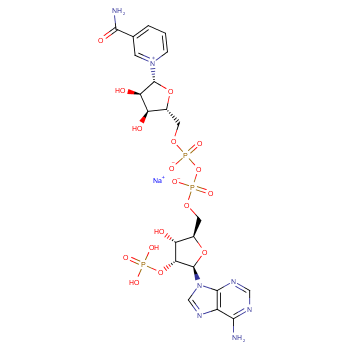
β-Nicotinamide adenine dinucleotide phosphate monosodium salt
- Model:1G,10G,1KG,5KG,25KG
- Createtime: 2026-07-02
- Updatetime: 2026-07-16
Product Details
| useage |
FOR R&D RESEARCH USE
|
| deliveryInfo |
|
| appearance |
white to off white powder
|
| aliasen |
|
| supplyCapacity |
50000000KG/Year
|
| harbor |
SHENZHEN
|
| minorder |
1KG
|
β-NADP? Monosodium Salt CAS 1184-16-3 Full English Technical Datasheet
1. Basic Chemical Information
-
CAS No.: 1184-16-3
-
Full Name: β-Nicotinamide Adenine Dinucleotide Phosphate, Oxidized Form, Monosodium Salt
-
Abbreviation: β-NADP?·Na / NADP Monosodium / TPN? Monosodium
-
Synonyms: Coenzyme II monosodium salt, Triphosphopyridine nucleotide monosodium salt, NADP Sodium Salt
-
IUPAC Name: sodium 1-[(2R,3R,4S,5R)-5-({[({[(2R,3R,4R,5R)-5-(6-amino-9H-purin-9-yl)-3-hydroxy-4-(phosphonooxy)oxolan-2-yl]methyl phosphonato}oxy)(oxido)phosphoryl]oxy}methyl)-3,4-dihydroxyoxolan-2-yl]-3-carbamoyl-1λ?-pyridin-1-ylium
-
Molecular Formula: C??H??N?NaO??P?
-
Molecular Weight: 765.40 g/mol (anhydrous)
-
MDL No.: MFCD00036262
-
PubChem CID: 87565510
2. Physical & Chemical Properties
|
Test Item
|
Standard Specification
|
|
Appearance
|
White to pale off-white crystalline powder
|
|
Odor
|
Odorless
|
|
Solubility
|
Freely soluble in purified water & neutral PBS buffer; slightly soluble in methanol; insoluble in ethanol, acetone, oils, alkanes
|
|
UV Characteristic Absorption
|
λmax = 260 nm; No absorbance at 340 nm (distinguish from NADPH)
|
|
UV Ratio (pH=7.0)
|
A???/A??? = 0.78–0.88; A???/A??? = 0.16–0.26
|
|
pH (1% aqueous solution)
|
5.2 ~ 6.8
|
|
Melting Point
|
175–178 °C (decompose)
|
|
Stability
|
Stable under cool, dark, sealed environment; less light-sensitive than NADPH; decomposes under high temperature, strong alkali & strong oxidants
|
|
Hygroscopicity
|
Moderately hygroscopic; avoid long-term exposure to air moisture
|
3. Quality Specifications (Biochemical / Diagnostic Reagent Grade)
|
QC Item
|
Standard Limit
|
Test Method
|
|
Assay (HPLC, anhydrous basis)
|
≥98.0%; Premium ≥99.0%
|
RP-HPLC UV 260 nm
|
|
Loss on Drying (KF)
|
≤0.70%
|
Karl Fischer Titration
|
|
Reduced NADPH Impurity
|
≤1.00%
|
HPLC UV 340 nm
|
|
Single Unknown Related Impurity
|
≤0.30%
|
HPLC
|
|
Total Related Impurities
|
≤1.00%
|
HPLC
|
|
Enzymatic Activity Verification
|
Pass G6PDH substrate activity test
|
UV Spectrophotometry
|
Heavy Metals
|
Heavy Metal
|
Limit
|
|
Lead (Pb)
|
≤0.5 ppm
|
|
Arsenic (As)
|
≤1.0 ppm
|
|
Cadmium (Cd)
|
≤0.1 ppm
|
|
Mercury (Hg)
|
≤0.1 ppm
|
Microbial Limits
|
Microbe Index
|
Standard
|
|
Total Aerobic Microbial Count
|
≤500 CFU/g
|
|
Yeast & Mold
|
≤50 CFU/g
|
|
Pathogens (E.coli, Salmonella, S. aureus)
|
Negative per 25g
|
4. Core Biochemical Mechanism & Biological Functions
-
Oxidized Form of Coenzyme II (NADP?)
The primary electron acceptor in pentose phosphate pathway; captures hydride to generate NADPH, the core reducing power for all anabolic metabolism.
-
Universal Dehydrogenase Cofactor
Indispensable co-substrate for glucose-6-phosphate dehydrogenase (G6PDH), 6-phosphogluconate dehydrogenase, cytochrome P450 monooxygenases, steroid reductases.
-
Antioxidant System Precursor
Continuous supply of NADPH to regenerate reduced glutathione (GSH), eliminating intracellular ROS and alleviating oxidative stress.
-
Gold Standard Substrate for Clinical IVD Kits
Core raw material for enzymatic cycling detection kits for G6PD deficiency screening, blood lipid, liver function, antioxidant biomarkers.
-
Biocatalysis Redox Cofactor
Applied in industrial biocatalytic reduction reactions for chiral alcohol, steroid and pharmaceutical intermediate synthesis.
5. Application Fields & Operation Tips
5.1 Clinical In Vitro Diagnostic Kits
-
G6PD deficiency neonatal screening kits, serum glutathione reductase assay, triglyceride & cholesterol enzymatic detection
-
Formula Tip: Prepare working buffer at pH 7.0–8.0 to maximize stability
5.2 Biochemical Laboratory Research
-
Pentose phosphate pathway, redox metabolism, enzyme kinetics research
-
Cell culture medium additive, biosensor raw material, high-throughput enzymatic screening
5.3 Pharmaceutical & Biocatalysis R&D
-
Chiral compound bioreduction, cytochrome P450 drug metabolism simulation, anti-oxidation new drug cell experiments
5.4 Raw Material for Antioxidant Research Formulations
Used as starting coenzyme to study cellular anti-aging & mitochondrial protection mechanisms
6. Safety Profile
-
Mild irritant to skin, eyes and respiratory tract upon direct inhalation or contact
-
Not for oral administration or direct cosmetic addition
-
No cytotoxicity under standard in-vitro biochemical working concentration
-
Lab operation requires nitrile gloves, safety goggles and dust mask